Evidence of the Late Iron Age (ca 1500-1800) is prevalent in the Suikerbosrand and Keyterskloof area. Stone kraals and remnants of stone dwellings, iron age tools, weapons and decorative beads, manufactured from iron and copper, have also been found.
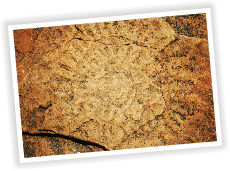
The Late Iron Age can be linked to rock art found in the district. A variety of petroglyphs (rock engravings) occur on the farm Waldrift and is known as the Redan rock art site. The 244 engravings identified at the site represent a few animal figures and many unusual geometric designs. The images are drawn with outlines only and were engraved by means of pecking with a sharp instrument.
The geometric images are particularly interesting because of their unusual nature and symmetry. Similar engravings have also been found on a small island near the Ascot Bridge in Vanderbijlpark. The images are mostly of animals and are fairly true to life. Elephant, Eland and Rhino have been identified.
ANGLO-BOER WAR
The Anglo-Boer War, or the South African War (1899-1902), ripped through the country when the two Boer Republics of the Orange Free State and Transvaal fought the British for independence. The British introduced the Scorched Earth Policy where Boer farms were destroyed, women, children and Black labourers were sent to concentration camps and Blockhouses were erected to protect railway lines.
Concentration camps were found in both the Heidelberg and Vereeniging districts. Heidelberg and Vereeniging both have concentration camp cemetery memorials that honour the lives lost in these camps. The largest of the Black concentration camps in the region was situated in Heidelberg. The cemetery of the victims lie close to the remains of the Blockhouses.
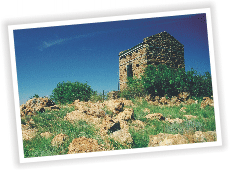
One of the only fifty remaining Blockhouses in the country is situated in the Meyerton area and is called the Witkop Blockhouse. Peace negotiations to end the war took place in Vereeniging at Vereeniging Brick and Tile. The tree stump under which negotiations took place is a heritage site. To honour the bravery of the Boers during the war, a monument was unveiled in 1961 in Vereeniging and is aptly called the Peace Monument.
LIBERATION STRUGGLE
The struggle for equal rights in South Africa began in our region and, coincidentally, ended here too.
The strong political activity that ensued for decades in our troubled townships began with the Evaton Bus Boycott of 1956 when residents boycotted bus services due to price increases.
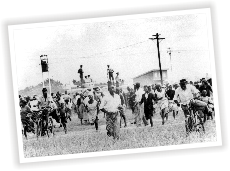
Political activity grew intense and the region was witness to many violent incidents, such as the Sharpeville Massacre of 1960, the Rent Boycott of 1984, the Sebokeng Night Vigil Massacre of 1991, the Heidelberg Bus Massacre of 1992 and the Boipatong Massacre of 1992. The first democratic government in 1994 recognised the human sacrifice made in the name of human equality in the region and it was decided that the new constitution of South Africa would be signed in Sharpeville on 10 December 1996. The venue was also chosen to honour the 69 victims of the Sharpeville Massacre.
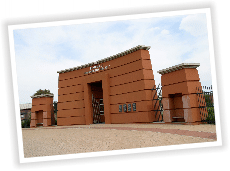
The community honoured the victims of political violence by erecting the Sharpeville Memorial and the Nangalembe Memorial (for the victims of the Sebokeng Night Vigil), and celebrates South Africa's democracy with Constitution Square, opened by Nelson Mandela on the day he signed the new Constitution.
HUMAN RIGHTS DAY
Every year in the month of March, the whole country's focus is on Sharpeville as an epicenter around which Human Rights Day is commemorated and the signing of the new Constitution is celebrated. Sharpeville has become a “Cradle of Human Rights” , which is a 180° turn from the beginning of serious repression and banning of the liberation movement to the end of the the struggle for freedom with the signing of the Constitution of South Africa.
Eco-tourism
SUIKERBOS RAND NATURE RESERVE
The Suikerbosrand Nature Reserve was named after the Transvaal Suikerbos, (Protea Caffra). The reserve is within an hours drive of Johannesburg and lies close to the town of Heidelberg. The list of mammals to be found in the reserve is quite long and includes Eland, Zebra, Black Wildebeest, Red Hartebeest and Brown Hyena.
A network of 66km of backpacking hiking trails have been established, plus a short, 4km long interpretive trail (Cheetah Trail) and a 17km (10km shorter option, Bokmakierie) day visitor trail. There is also a 60km long motor vehicle tourist route.The flora in the reserve is surprisingly varied and includes a large number of grass species. Trees include the White Stinkwood (Celtis africana), Highveld Cabbage Tree (Cussonia paniculata), Ouhout (Leucosidea sericea), Sweet Thorn (Acacia Karroo), Highveld Protea/Suikerbos (Protea caffra) after which the reserve is named and the Common Guarrie (Euclea undulata).
Wild flowers include the Agapanthus (Agapanthus campanulatus), Disseldoring (Berkeya seminivea), Wild Sweat Pea (Sphenostylis angustifolia), Orange River Lily (Crinum bulbispernum) and the Large Witchwood (Striga elegans)
The reserve has caravan and camping facilities, chalets and conference facilities, as well the Diepkloof Farm Museum. Many activities are on offer at the Museum.
Discovered in Heidelberg in 1959, the Chrysoritisaureus or Heidelberg Copper Butterfly, is a rare species that is unique to the Heidelberg area and is being conserved in the Alice Glöckner Nature Reserve.
Contact:
Cell: 011 439 6300
Function Venues
CORPORATE AND BUSINESS
The Vaal has outstanding conference and accommodation facilities for day or strategic sessions away. Within easy reach from the rest of Gauteng, the region will offer your organisation relaxed settings to get the job done.
Many venues in the region focus on wedding and special function planning and specialists in this field will offer unique and affordable packages, as well as assisting you with other contacts you may need - from photographers to organising bachelor parties. Within close proximity to the rest of Gauteng, out of towners will be able to arrange their special day easily and conveniently.
Most of the Graded function venues listed will gladly assist you.
Or for more information, please contact Vaal Wedding Association.
Every winter a dozen or more Vaal venues align themselves with the best South African Wine Estates and each become a mini Wine Estate – representing wines from those Vineyards and immersing themselves in treating guests to an experience of fine wine tasting.
If you want to organize a corporate or private group outing during this 5 week event – there are a number of packages to choose from or a package can be tailor made for your individual needs.
The Vaal Dam has over 800kms of coast line and covers an area in excess of three hundred square kilometres. It is South Africa's biggest dam by area and the third largest by volume.
The dam is unique in that three provinces make up the coastline. The Free State is the largest by area, Mpumalanga has a beautiful but rural coastline and the most active by far is the Gauteng coastline, where Vaal Marina is situated.
RIVER CRUISES
The Vaal River and Vaal Dam caters for all water sport enthusiasts and is the playground for the adventurous spirit.
For a more tranquil adventure, spend a weekend cruising the 55km of river on a houseboat, where professionals are on standby to teach and assist you in navigating your very own floating cabin. Shorter, navigated cruises promise an idyllic setting for an afternoon of pure pleasure.
UPPER VAAL RIVER RAFTING
The upper Vaal River offers small to big rapids along this stretch and is a great day out for the less experienced or the experienced rafter.
It is always advisable to book your day out rafting with an experienced guide who is familiar with the area.
Bass Lake consists of a 10-hectare body of spring-fed water and is one of the best scuba training venues in the country. Depths vary from a walk in slope to 23m at the deepest point.
There are training grids at various depths for Scuba Skills training, as well as a number of interesting wrecks for more experienced divers
Bass Lake is not only frequented by Scuba Schools with their students, but also by social divers.















 Evidence of the Late Iron Age (ca 1500-1800) is prevalent in the Suikerbosrand and Keyterskloof area. Stone kraals and remnants of stone dwellings, iron age tools, weapons and decorative beads, manufactured from iron and copper, have also been found.
  The Anglo-Boer War, or the South African War (1899-1902), ripped through the country when the two Boer Republics of the Orange Free State and Transvaal fought the British for independence. The British introduced the Scorched Earth Policy where Boer farms were destroyed, women, children and Black labourers were sent to concentration camps and Blockhouses were erected to protect railway lines.
 The struggle for equal rights in South Africa began in our region and, coincidentally, ended here too.
 Every year in the month of March, the whole country's focus is on Sharpeville as an epicenter around which Human Rights Day is commemorated and the signing of the new Constitution is celebrated. Sharpeville has become a “Cradle of Human Rights” , which is a 180° turn from the beginning of serious repression and banning of the liberation movement to the end of the the struggle for freedom with the signing of the Constitution of South Africa.
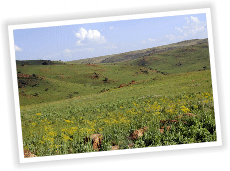 The Suikerbosrand Nature Reserve was named after the Transvaal Suikerbos, (Protea Caffra). The reserve is within an hours drive of Johannesburg and lies close to the town of Heidelberg. The list of mammals to be found in the reserve is quite long and includes Eland, Zebra, Black Wildebeest, Red Hartebeest and Brown Hyena.
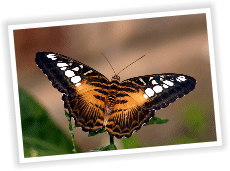 Discovered in Heidelberg in 1959, the Chrysoritisaureus or Heidelberg Copper Butterfly, is a rare species that is unique to the Heidelberg area and is being conserved in the Alice Glöckner Nature Reserve.
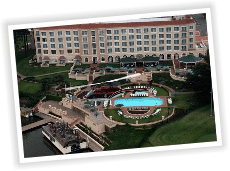 The Vaal has outstanding conference and accommodation facilities for day or strategic sessions away. Within easy reach from the rest of Gauteng, the region will offer your organisation relaxed settings to get the job done.
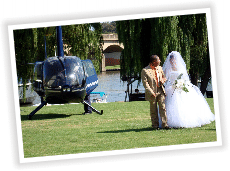 Many venues in the region focus on wedding and special function planning and specialists in this field will offer unique and affordable packages, as well as assisting you with other contacts you may need - from photographers to organising bachelor parties. Within close proximity to the rest of Gauteng, out of towners will be able to arrange their special day easily and conveniently.
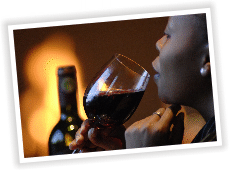 Every winter a dozen or more Vaal venues align themselves with the best South African Wine Estates and each become a mini Wine Estate – representing wines from those Vineyards and immersing themselves in treating guests to an experience of fine wine tasting.
 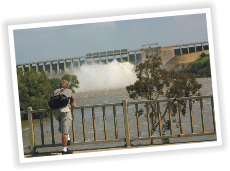 The Vaal Dam has over 800kms of coast line and covers an area in excess of three hundred square kilometres. It is South Africa's biggest dam by area and the third largest by volume.
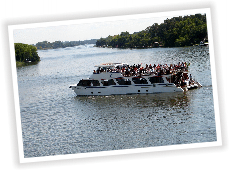 The Vaal River and Vaal Dam caters for all water sport enthusiasts and is the playground for the adventurous spirit.
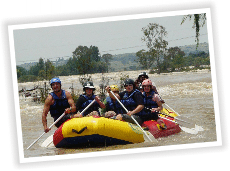 The upper Vaal River offers small to big rapids along this stretch and is a great day out for the less experienced or the experienced rafter.
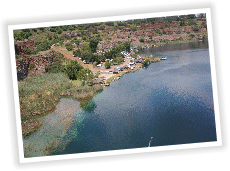 Bass Lake consists of a 10-hectare body of spring-fed water and is one of the best scuba training venues in the country. Depths vary from a walk in slope to 23m at the deepest point.